Exploration · Game systems · 3D prototype / 2025
Liminalité
Making a changing identity visible through play.
Liminalité explores how our sense of self changes as we enter new relationships, teams, and environments. It makes that idea playable through a crystal whose form, color, and composition respond to encounters. In the 3D game, players climb a spiral tower, gathering and shedding fragments; changes persist between floors, so each encounter shapes the conditions of the next.
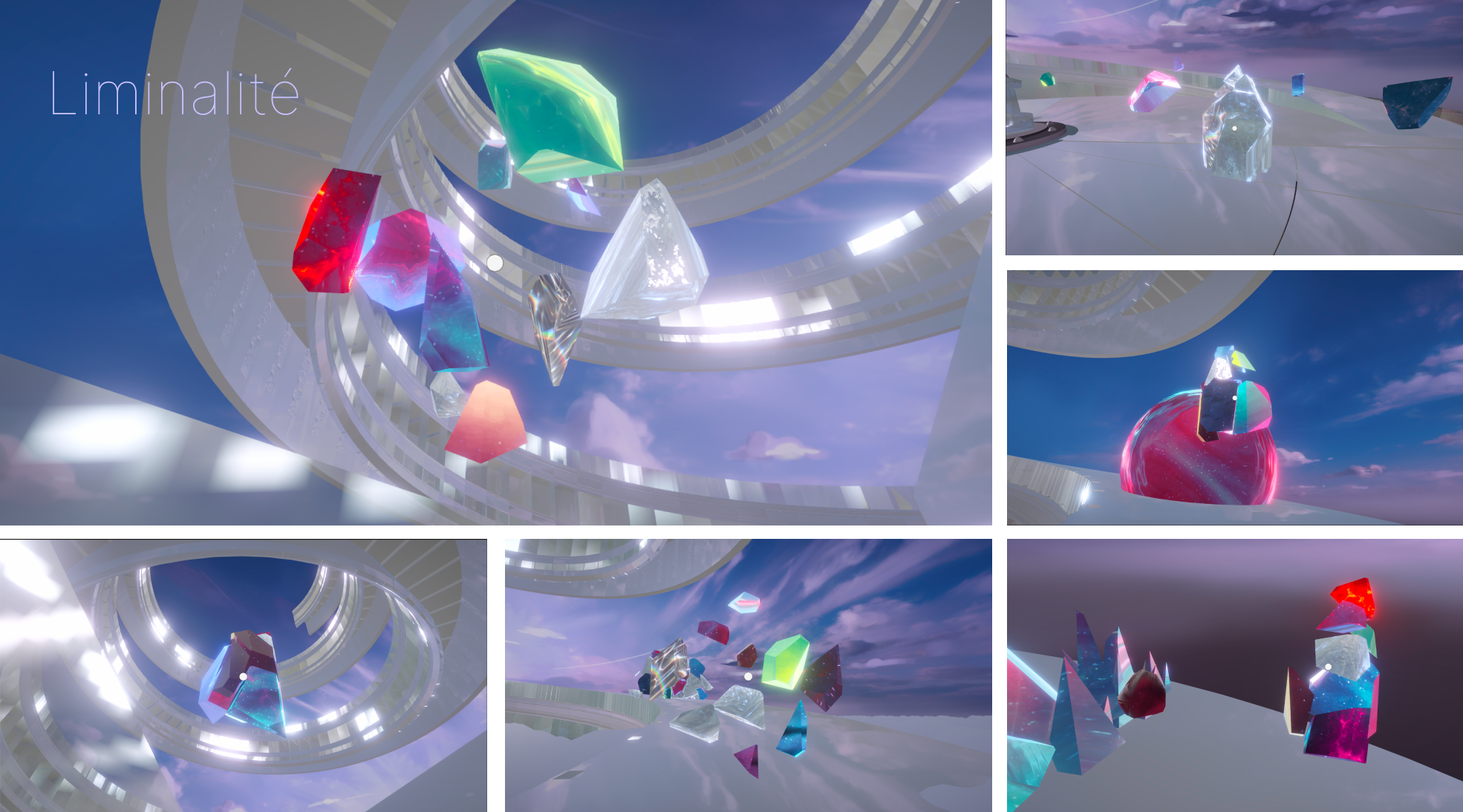
Every encounter leaves a trace.
The player’s crystal can gather or fragment. Structure, color, and composition carry forward across levels, so an encounter changes both the crystal’s appearance and its state for the next floor.
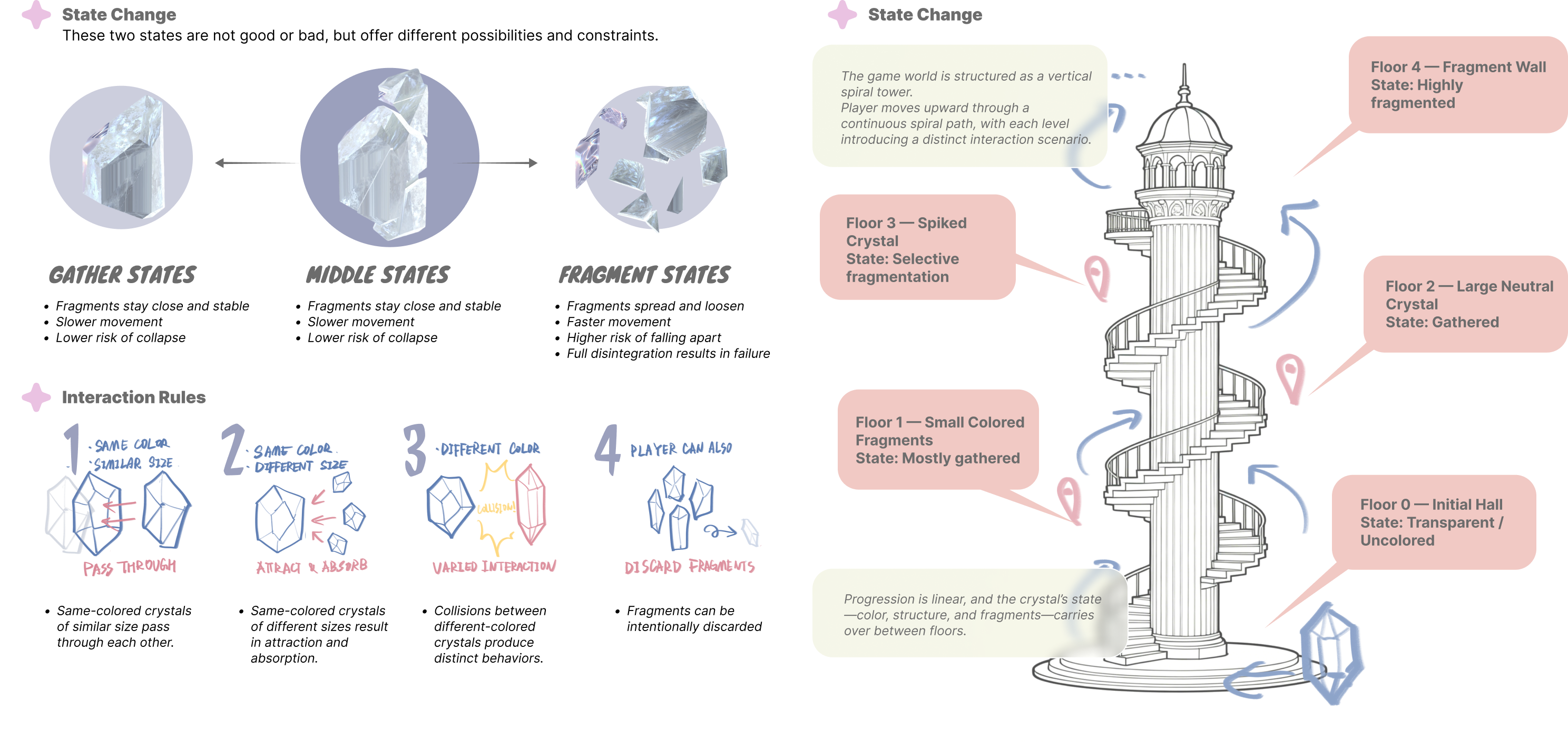
Gather, fragment, carry forward.
Crystals of the same color and similar size pass through one another. Different sizes of the same color attract and absorb; different colors create varied interactions. Players can also discard fragments.
Five floors, one continuous state.
The spiral tower begins with a transparent, uncolored crystal and progresses through colored fragments, a large neutral crystal, spiked forms, and a fragment wall. Each floor introduces an encounter while carrying the player’s color, structure, and fragments forward.
- Floor 0 · Initial hallTransparent, uncolored crystal.
- Floor 1 · Small colored fragmentsMostly gathered state.
- Floor 2 · Large neutral crystalGathered state.
- Floor 3 · Spiked crystalSelective fragmentation.
- Floor 4 · Fragment wallHighly fragmented state.
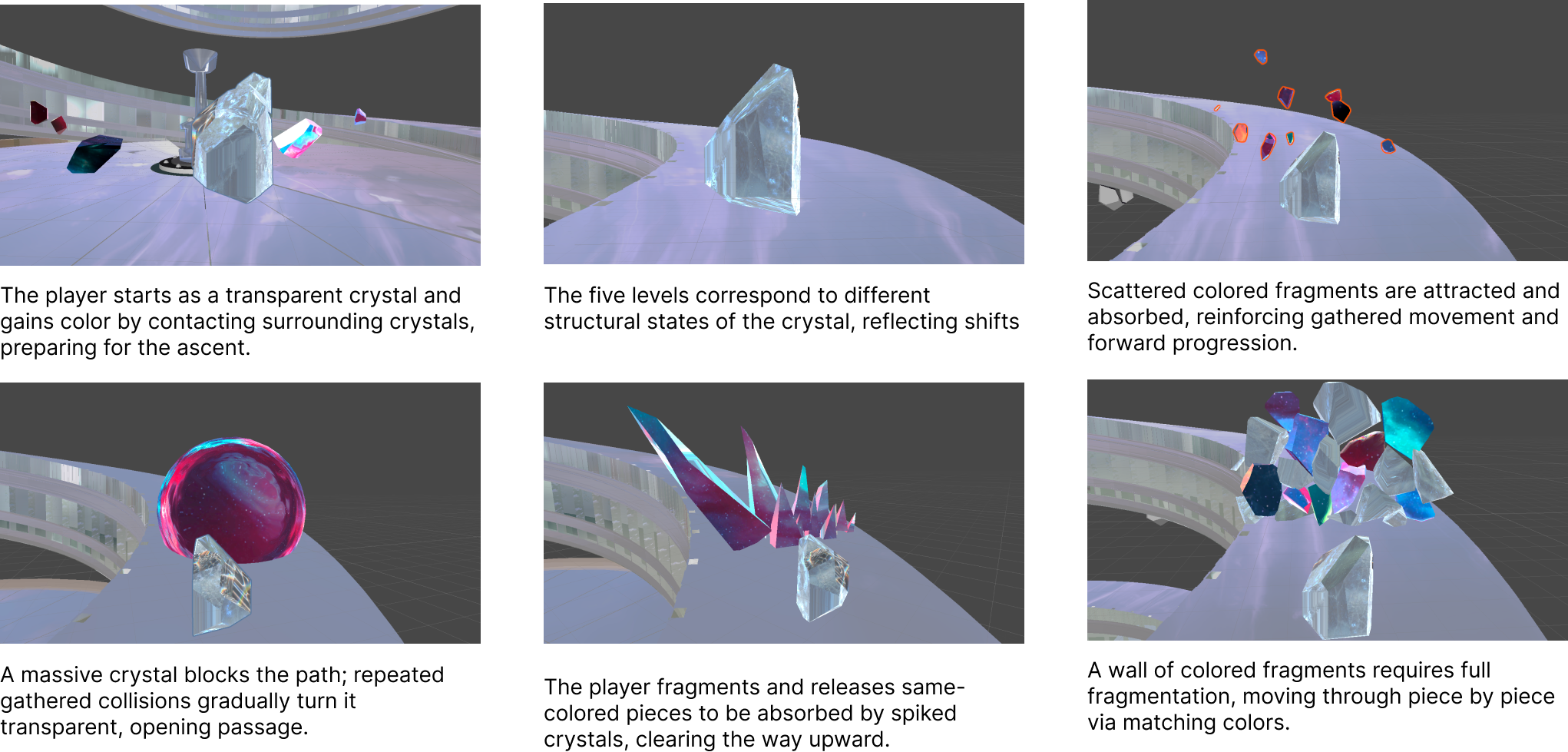
The player is the interface.
Transformation is visible in the crystal itself. The 3D scenes connect each encounter through a persistent state, rather than resetting the player’s form.